

8 min read

Mastering PCMH maintenance: Why shortcuts could put your 2027 readiness at risk

Mastering PCMH maintenance
Mastering PCMH maintenance: Why shortcuts could put your 2027 readiness at risk
16:03

National Committee for Quality Assurance's (NCQA) Patient-Centered Medical Home (PCHM) recognition is not a project with a defined end date. It is an ongoing commitment by the entire care team to provide patient-centered, outcome-focused care. That means maintaining your PCMH should involve more than preparing for annual reporting once a year.

Practices should regularly evaluate whether the policies, workflows and documentation behind their recognition are still working as intended. Staff change. Technology advances. Workflows evolve. And PCMH evidence and expectations change too.

That philosophy is at the heart of our Mastering the Maintenance playbook, which provides practical strategies to help practices sustain PCMH recognition while keeping their approach relevant, accountable and audit-ready. Heading into 2027, that approach matters even more.

Changes involving prevalidation credits, along with the continued use of shared criteria across multisite organizations, highlight an important PCMH maintenance lesson: a shortcut that makes recognition or reporting easier does not necessarily mean your practice is prepared to demonstrate the work behind it.

Don't rely on the shortcuts. PCMH is not a project with a defined end date. It's a commitment by the entire care team to provide patient-centered, outcome-focused care from commitment to success phases. 

Mandi Diamond Mandi Diamond, PCMH CCE Sr. Practice Transformation Advisor

Key takeaways

  • PCMH maintenance should happen throughout the year, not just during annual reporting.
  • Electronic medical record (EMR) functionality approval tables do not necessarily prove that staff have adopted and consistently follow the workflow behind a criterion.
  • Annual reporting can expose gaps that were previously obscured by prevalidation. can expose gaps that were previously obscured by prevalidation.
  • While annual reporting allows for shared evidence, it is wise to collect evidence for all sites at minimum annually to ensure integrity of the PCMH.
  • Maintaining evidence for every applicable criterion can help reduce last-minute reporting and facilitate audit preparation.
  • Routine, nonpunitive internal audits can identify opportunities for additional training and workflow improvement.


PCMH recognition is an ongoing commitment

The PCMH journey does not end when recognition is achieved. Practices move from learning and applying PCMH concepts into a sustained process of annual reporting and continuous improvement.

Although sustaining PCMH provides formal opportunities to evaluate PCMH development, waiting for check-ins or annual reporting to assess your program can leave important gaps undetected. It’s important to implement strategies and workflows that would allow you to demonstrate any part of your PCMH recognition at any time.

For example, you could ask yourself or your team responsible for PCMH: "If we had to demonstrate any criteria of our PCMH today, could we?"

Being able to say “yes” honestly and accurately is central to mastering PCMH maintenance.


What the retirement of prevalidation credits can teach practices

Historically, practices in the transformation phase could receive credit for certain core and elective criteria based on their use of an EMR with qualifying functionality. Beginning Jan. 1, newly transforming practices will no longer have prevalidation EMR auto-credits to rely on.

What does this mean for practices: Four considerations

While pre-validation could streamline the recognition process, auto credit did not necessarily demonstrate that the underlying workflow was fully implemented and consistently followed across the practice. That distinction matters for four key reasons.

1. Prevalidation does not replace annual reporting requirements

Practices still need to demonstrate the requirements selected for annual reporting through applicable reports, policies and other evidence, as leaning on prevalidation was never applicable to reporting. Because annual reporting requirements are drawn from the PCMH core criteria and can change from year to year, practices should maintain evidence across their PCMH program instead of preparing only the criteria requested in the current reporting cycle.

2. Annual reporting requirements can uncover an existing workflow gap


Knowing and Managing Your Patients (AR-KM)

       
AR-KM 1: Comprehensive Health Assessment Required Shared KM 02 Core
AR-KM 2: Demographic Data Collection Required Site-specific KM 09 Core

​*Source: PCMH Annual Reporting Requirements 2027

The 2027 annual reporting requirements in the Knowing and Managing Your Patients concept area include evidence related to comprehensive health assessment documentation and capturing and reporting information about patient populations.

An EMR may have functionality that supports these activities. But if a practice previously relied on prevalidation, the team may not have fully assessed how consistently that functionality is being used in day-to-day workflows. For example:

  • Are staff consistently completing the required documentation?
  • Is the information captured in the correct location?
  • Are the same processes followed during well visits and new-patient assessments?
  • Can the practice report on the information it collects?
  • Can the practice produce evidence showing that the workflow is being followed?

If those questions have not been tested, prevalidation can create a blind spot between what the EMR is capable of doing and what the practice is actually doing.

3. The gap may not become obvious until evidence is requested

When a criterion that was previously supported by prevalidated EMR functionality becomes part of annual reporting, a practice may discover that its documentation or workflow is not as complete as expected.

Instead of simply producing evidence, a team may have to conduct a gap analysis, retrain staff or revise workflows while also preparing for annual reporting. That is exactly the situation ongoing PCMH maintenance is intended to prevent.

4. The impact goes beyond annual reporting

This isn't just about being able to produce evidence for NCQA. Consistently capturing information about a patient's medical, behavioral and social needs can help practices better understand their patient populations, provide a more inclusive environment, identify care gaps and determine where proactive interventions may be appropriate.

When those workflows exist in the EMR but aren't consistently carried out in practice, the missed opportunity isn't simply an incomplete report. It's information the care team could have been using to support patient-centered care. That's why maintaining PCMH requires practices to look beyond whether they received credit for a criterion and ask a more meaningful question: can we demonstrate that the workflow behind this requirement is actually working in our practice?


Don't let PCMH maintenance become a check-the-box exercise

DataGen's approach to PCMH transformation and sustainment has not been to rely solely on prevalidation or auto-credit. Instead, the goal is to challenge practices to demonstrate the core and selected elective criteria that form the foundation of their individual PCMH programs during both transformation and sustainment. When they cannot, that gap becomes an opportunity for education and workflow development. The answer may not be the same for every practice. A workable process needs to consider:

  • PCMH requirements and best practices;
  • existing technology;
  • available resources;
  • staff responsibilities;
  • current workflows; and
  • the needs and preferences of the individual site.

The goal is to build a workflow the practice can realistically maintain.


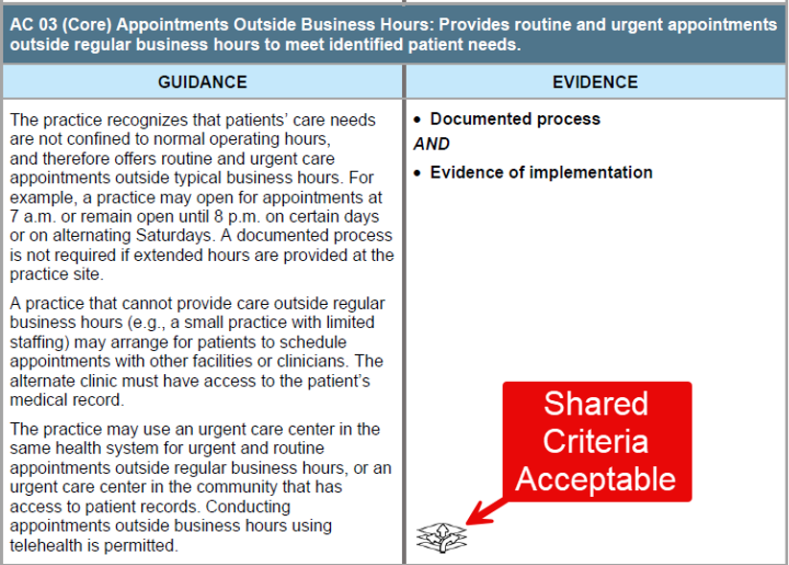
Shared criteria can create another PCMH maintenance blind spot


Example one of what shared criteria looks like

​

*Source: PCMH Standards and Guidelines 11.1


Example two of what shared criteria looks like

Care Coordination and Care Transitions (AR-CC)        
AR-CC 1: Referral Management Required Shared CC 04C Core
AR-CC 2: Post-Hospital/ED Visit Follow-Up Required Shared CC 16 Core

​*Source: PCMH Annual Reporting Requirements 2027

Prevalidation and shared criteria can inadvertently create a false sense of readiness. For multisite organizations, certain PCMH criteria allow evidence and documentation to be shared rather than requiring every individual site to submit the same information.

This can make transformation and annual reporting more efficient, but shared evidence also comes with an assumption: the locations using that evidence have actually adopted the shared policy and workflow.

That assumption needs to be tested. If one location provides evidence for a shared criterion, ask yourself:

  • Could another location in the organization demonstrate that same process?
  • Could staff explain the policy?
  • Could they show how the workflow operates at their location?
  • Could they produce site-level evidence when appropriate?

If the answer to any of those questions is no, your PCMH annual reporting could be at risk. Even when evidence qualifies to be shared, the underlying criterion must remain part of each location's PCMH transformation and maintenance strategy. It’s essential to ask these questions before documentation is requested and take steps to ensure shared evidence doesn't become shared assumptions.


Build a PCMH audit prep book

How do you avoid these maintenance gaps?

One practical step is to create a PCMH audit prep book for the offices you oversee. This doesn't need to be a physical binder.

Your prep book can live in a shared drive or another accessible platform. What matters is creating an organized, repeatable system in which PCMH leaders and staff can quickly find the policies and evidence associated with their requirements. Organize the prep book around the PCMH concept areas and document the core and elective criteria your practice has achieved. For each criterion, consider tracking:

  • applicable criterion;
  • policy;
  • supporting evidence;
  • shared or site-specific status;
  • audit readiness;
  • current annual reporting applicability; and
  • notes or identified gaps.

The important distinction is that your prep book shouldn't contain only the criteria requested for annual reporting that year. Maintain evidence for your broader PCMH program.


Example of a "Concept Area - TC" audit prep book

      Concept Area - TC      
Criteria Policy Evidence Shared/Per Site Audit Ready? Needed for Annual Reporting Notes?
Transformation Leads both clinical and PCMH
Team Based Care Policy
Documentation of Leads
Shared
Yes, we have updated the leads on policy
YES 2027
Ensure all sites have access to shared drive with policies and evidence.
Organizational Chart and Job Descriptions/Accountabilities
Team Based Care Policy
Staff Structure and Job Descriptions
Shared
Yes, organizational chart amended in policy with latest job descriptions
YES 2027
 
Huddles and Patient Preparation
Team Based Care Policy
Huddle Examples
Shared policy ONLY
In progress. We collected 3 huddles per site from the week of 10.11.2026 and saved in shared drive. Dr. Knoll’s site is still outstanding. See notes:
N/A
 
Quality Improvement Team Based Activities and Sharing
Team Based Care Policy and Quality Improvement Policy
QI team meeting minutes with attendance
Shared
Yes, we have minutes and agenda from meeting on 10.1.2026
N/A
 
Utilizing a Certified EMR
N/A
Proof from the EMR Vendor
Shared
Letter on file with Office Managers
N/A


The annual reporting criteria requested from year to year can change. Maintaining supporting information throughout the year puts your practice in a stronger position when a different requirement is selected for review.


Your policies should match reality

As part of this process, review the policies associated with each PCMH concept area regularly. This is important because internal workflows shift, staff change, technology advances, and PCMH evidence and expectations evolve as well.

That's why on top of having a policy, you also need evidence that your practice is doing what the policy says. For example, if your policy says your practice conducts quality improvement meetings quarterly, you should be able to produce documentation supporting those quarterly meetings.

If the practice is no longer operating that way, don't simply let the policy become outdated. Review whether the policy should be amended to accurately reflect the new workflow while continuing to capture the intent of the applicable PCMH criterion and its expectations.

Maintenance reminder: While your policies tell your story, evidence proves your story. Are your workflows representative of the standards you have memorialized in your policies?  

Mandi Diamond Mandi Diamond, PCMH CCE Sr. Practice Transformation Advisor

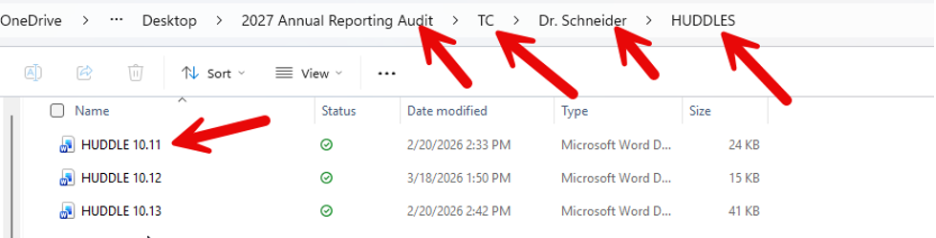
Make your PCMH evidence easy to find

Documentation is only helpful if staff can retrieve it. Use a shared drive or another accessible location with a clear, consistent naming convention. Consider organizing documentation by:

Year → Concept Area → Site → Criterion → Evidence


Your exact system may differ, but consistency matters. If a team has to search through emails, individual desktops or vaguely named folders every time evidence is requested, that is another maintenance gap worth addressing.

A central evidence structure also helps when practices experience staff turnover, EMR changes or other operational transitions that require additional education and support. 

Example of what your system might look like


Don't wait for an audit to test your PCMH

Here's another simple way to put your maintenance strategy to the test: audit yourself.

Periodically select requirements from across the six PCMH concept areas and ask individual sites to provide the associated evidence.

  • Can staff locate it?
  • Is it current?
  • Does it match the policy?
  • Does the site's workflow match what the organization says it does?
  • Is the evidence strong enough to demonstrate the criterion?

These exercises shouldn't be punitive. A random mini audit is an opportunity to recognize what staff are doing well while uncovering processes that need additional attention. If a gap is identified, practice leadership and staff can work together to determine whether the answer is additional training, better documentation or a redesigned workflow.

That turns audit preparation into an ongoing improvement process rather than a last-minute scramble.


Your PCMH maintenance checklist for 2027

Ask your team:

  • Can we demonstrate every core and selected elective criterion that makes up our PCMH?
  • Have we reviewed the policies associated with each concept area?
  • Do those policies still reflect our actual workflows?
  • Are staff consistently following those workflows?
  • Are we collecting evidence throughout the year or only for current annual reporting requirements?
  • Could an individual site demonstrate a shared criterion?
  • Do our systems make PCMH evidence easy to find?
  • Have staff turnover or EMR changes created new gaps?
  • Are we periodically testing our readiness through internal mini-audits?
  • When we identify a gap, do we have a process for training, rebuilding or improving the workflow?

If you're struggling to answer any of these questions, you've identified an opportunity to strengthen your PCMH. Check out our blog posts on 2027 PCMH annual reporting and NCQA updates to PCMH standards for 2027.


How DataGen can help

PCMH maintenance shouldn't mean recreating your program every time requirements change. DataGen can help practices evaluate whether their documented PCMH processes match what's happening at the site level, identify evidence and workflow gaps, and build sustainable approaches to transformation, annual reporting and ongoing maintenance.

Talk with DataGen about strengthening your PCMH maintenance strategy and preparing for what's ahead in 2027.

FQHCs: Achieve PCMH recognition faster with HRSA-funded expert support

FQHCs: Achieve PCMH recognition faster with HRSA-funded expert support

FQHCs pursuing PCMH recognition can access HRSA-funded technical assistance. Partner with Mandi Diamond and DataGen for expert guidance, workflows,...


Read More
PCMH annual reporting 2027: What practices should review before submission

PCMH annual reporting 2027: What practices should review before submission

Prepare for the 2027 PCMH annual reporting cycle by reviewing key practices and leveraging shared opportunities for efficient documentation and...

Read More
PCMH 11.1 updates 2026: FAQs for NCQA recognition and compliance

PCMH 11.1 updates 2026: FAQs for NCQA recognition and compliance

Discover essential updates in the 2026 NCQA PCMH Standards Version 11.1 and learn how to maintain compliance while enhancing patient-centered care.

Read More