

1 min read
CY 2026 Home Health PPS final rule: Key payment and policy updates
 Lauren Alvarenga : September 11, 2025
2 min read

The pursuit of health equity in the United States has become more critical as healthcare disparities continue to affect millions of Americans. Socioeconomic status and access to healthcare services are pivotal in determining health outcomes, leaving underserved populations at a disadvantage. To address these issues, the Centers for Medicare and Medicaid Services (CMS) introduced changes in the Medicare Value-Based Purchasing (VBP) Program to incentivize quality care for all.
In this blog, we provide an update, discuss recent data and analyze the national impact. Read on for our interpretation of the CMS VBP Program and how it aims to advance health equity.
The Hospital VBP Program aims to reward acute care hospitals with incentive payments based on their quality of care. This initiative ties a portion of Medicare payments to performance on quality measures, putting 2.0% of a hospital's base operating IPPS revenue at risk. CMS reallocates this amount to hospitals demonstrating superior performance compared to their peers.
With the federal fiscal year 2026 program, CMS is introducing the Health Equity Adjustment (HEA), which provides additional bonus points to hospitals that excel in delivering care to underserved populations. According to the CMS FFY 2024 IPPS final rule, "Healthcare disparities exist among patients throughout the United States, and certain patient characteristics such as socioeconomic status are associated with worse health outcomes."
The HEA aims to bridge the performance gap between hospitals by rewarding those offering excellent care to dual-eligible patients — people eligible for both Medicare and Medicaid. This "bonus" is earned based on a hospital's performance across four domains:
person and community engagement;
clinical outcomes;
safety; and
efficiency and cost reduction.
CMS uses an “underserved” multiplier when calculating these bonus points, reflecting the hospital’s ratio of full-benefit, dual-eligible patients to total Medicare stays. While this arrangement highlights the importance of serving disadvantaged groups, it also underscores the need for hospitals to improve their overall care quality, as pointed out by CMS in its National Quality Strategy.
“Achieving health equity, addressing health disparities, and closing the performance gap in the quality of care provided to populations that have been disadvantaged, marginalized, and/or underserved by the healthcare system continue to be priorities for CMS as outlined in the CMS National Quality Strategy,” reports CMS.
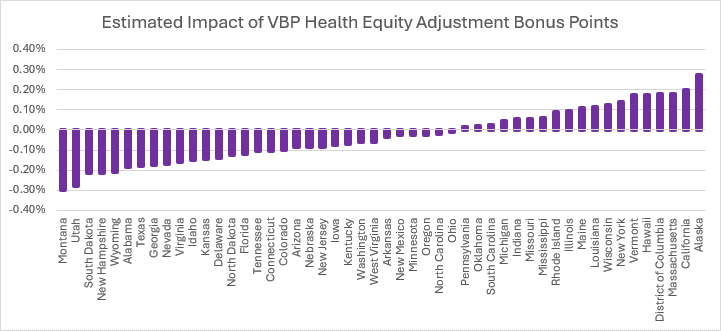 |
| DataGen estimates the financial impact on hospitals throughout the country in this graphic. |
The HEA introduces a competitive element and is "purposefully designed not to reward poor quality," focusing on hospitals with a higher underserved multiplier. This change compels healthcare systems to elevate care standards, ensuring equitable access and better outcomes across all patient demographics.
This shift presents challenges and opportunities for hospital administrators and healthcare professionals. Those excelling in the HEA will benefit from a larger share of the VBP pool, while others risk financial repercussions. It is essential for hospitals to align their practices with CMS’ broader objectives, such as achieving health equity and closing the performance gap.
Incorporating health equity into the Medicare VBP Program marks a significant step toward addressing healthcare disparities. By incentivizing high-quality care for all, CMS aims to reduce barriers and enhance outcomes for underserved communities. Hospitals must seize this opportunity to transform their practices, striving for excellence and inclusivity in patient care.
To learn more about how your hospital can leverage these changes, contact our team of experts today. DataGen provides Medicare fee-for-service policy analytics to countless health systems and hospitals so they can quickly digest payment policy analyses and summaries to create superior organizational decisions. Stay ahead of Medicare quality programs and contact us today.
This content is for informational purposes only. It has been partially generated from an AI language model, which may not always be exhaustive or tailored to individual circumstances. We encourage you to contact one of our experts for more information. We assume no liability arising from any use of this content.

1 min read
Lauren Alvarenga : September 11, 2025

1 min read
Lauren Alvarenga : September 12, 2025

1 min read
Want to supercharge your health and total cost of care strategy? Medicare Accountable Care Organizations can now access CMS shadow bundle data.