



1 min read
2 min read

Six social risk factors and their drivers
Social risk is a measure of vulnerability as defined by specific social determinants of health (SDOH). DataGen uses the following six SDOH categories.| Social Determinants of Health
|
|||
| Category
|
Defined by
|
Individual risk drivers
|
Community risk influencers
|
| Digital
|
Access, affordability and literacy
|
Competency
|
Resources
|
| Finance
|
Strength, resources and resiliency
|
Financial assets, liabilities and opportunities
|
Income, cost of living and opportunity
|
| Food
|
Sufficient access and affordability
|
Healthy foods and food literacy
|
Same
|
| Health literacy
|
Healthcare access, navigation, comprehension and adherence
|
Culture, demographics and education
|
Same
|
| Housing
|
Standard of living
|
Stability, quality and crowding
|
Same + overall affordability
|
| Transportation
|
Adequacy related to healthcare
|
Access, proximity and mobility
|
Access and proximity
|
Each category includes drivers that help calculate social risk (none to high) and prioritize need. Numerous data points and sources for each social determinant can help hospitals design interventions that transition individuals and communities from struggling to thriving.
The importance of an analytics-informed approach
Measuring social risk is new to most healthcare stakeholders. An analytics-informed approach — in addition to community partnerships — is needed to accurately identify, prioritize, measure and evaluate SDOH interventions. Such an approach also requires SDOH-specific data that are diverse, granular to the sub-ZIP code level and can be integrated with existing EHR and claims data. The result is empowered understanding for measurable return on investment, one of the most difficult SDOH objectives to achieve.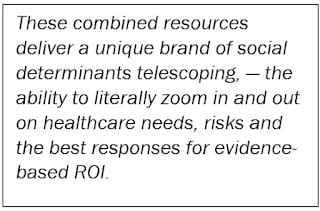
Three DataGen advantages make us the ideal social risk analytics partner:
- First, we understand the unique needs of hospitals and health systems.
- Second, we are able to license market-leading SDOH data and analytics from our partner, Socially Determined.
- Third, our data and capabilities free up resources by integrating Socially Determined’s social metrics with your data for new and powerful insights.
Three social risk advantages
Measuring social risk is vital to providing the right help to the right people at the right time. Social risk analytics are also the perfect companion to the Community Health Needs Assessment and can strengthen collaboration between hospitals and the growing list of partners needed to address CHNA findings. In addition, a new standard of care is emerging that links health equity to advanced payment models.Providers must be prepared.
A recent DataGen poll showed that more than 20% of health systems are not yet involved in SDOH activities. Among those that are, measuring results and ROI is one of the biggest challenges, yet many providers have not yet moved beyond claims data or determined how to best analyze the limited information they have.
Now is the time for providers to choose empowerment through a wealth of new SDOH data and analytics. Individuals at risk and the communities they call home are counting on it.

1 min read
Transportation Risk and SDOH: More Than Miles
Not owning a vehicle in New York City has negligible impact on a person’s health. Not owning one in a rural area — or even a booming metropolis like...